





 +86 18310268158

Stamping vs Laser Cutting: Which One for Your Part
Stamping vs laser cutting is a cost decision before it is a quality debate. Both processes cut the same sheet. They disagree on volume, thickness, setup and time. Pick the wrong one and you pay for it on every single part. Our factory in Nanpi, Hebei, runs both under one roof. 40+ presses from 60T to 400T, and a 6kW laser next to them. This guide lays the two processes side by side, names the crossover point and shows the hybrid route. The numbers below are the ones our engineers use daily.
The Two Processes, One Line Each
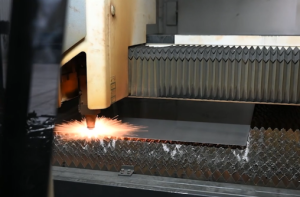
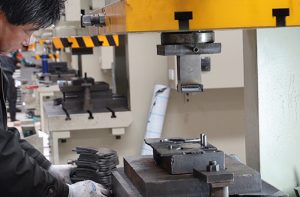
- Stamping: a die cuts and forms the part in a single hit, hundreds of times an hour.
- Laser cutting: a beam follows a file and cuts the profile, no tool at all.
One carries a tooling cost and a cycle rate. The other carries a file and a beam. Everything else in this guide follows from that difference. There is no debate about quality. Both hold the part to the drawing, to the class you name.
Side by Side
| Factor | Stamping | Laser cutting |
|---|---|---|
| Tooling cost | High, once | None |
| Unit cost at volume | Falls with every piece | Flat, per minute of beam |
| Throughput | Hundreds per hour | Minutes per part |
| Thickness range | Thin to medium sheet | Thin to thick plate |
| Feature detail | Set by the die | Set by the file |
| Forming in one step | Yes, by the die | Cut only, form after |
| Prototype speed | Weeks, for the die | Days, for the file |
Read the table top to bottom. The first two lines are the whole argument. Stamping buys you a falling unit cost. Laser buys you a zero setup. Which line matters depends on one number: how many parts, how often.
Where Laser Cutting Wins
- Prototypes and first articles, before any die exists.
- Low volume: hundreds, not tens of thousands, a year.
- Thick plate that a stamping die cannot bite.
- Complex 2D detail, where the die would be a puzzle.
- Designs that still change every month.
If the drawing changes, the die dies with it. The file does not. A part that is still being designed belongs on the laser, and it stays there until the shape freezes. Our laser cutting service runs that route daily, from a single part to a mixed batch.
Where Stamping Wins
- Volume: a few thousand units a year and climbing.
- Repeating geometry that a die can hold forever.
- Parts that are cut and formed in one hit.
- Long runs where the unit price must keep falling.
- Consistency across hundreds of thousands of pieces.
The die remembers the part. Every hit repeats the last one, to the same datum. That memory is the whole value of the tool. It is why a high-volume part stops being a cutting problem. It becomes a forming problem. Our metal stamping service runs those jobs on the presses, die by die, tracked by job number.
The Crossover Point
There is a number where the two lines cross. Below it, the laser is cheaper. Above it, the die pays for itself. For most parts it sits around a few thousand units a year. A simple clip crosses early. A complex bracket with formed features crosses later, because its die costs more. The crossing point moves with the part, not with the factory. That number is the answer the stamping vs laser cutting debate keeps asking for. Send your annual volume and your drawing, and the answer comes with the quote, as a number, not a feeling. That is the one question every process decision reduces to.
Cost, Line by Line
- Stamping: die once, then a unit price that falls with volume.
- Laser: no die, a price per minute of beam, flat at any volume.
- Material: the same coil, the same mill, in both columns.
- Forming: free in the die, extra in the brake after the cut.
Two quotes for the same part can differ by a third. The gap hides in the die line and the forming line. Our posts on metal stamping cost and on laser cutting cost split both columns into steps. Compare like for like, or the number means nothing. The material line should be identical in both quotes. If it is not, one of the two is quoting a different steel.
The Hybrid Route
Some parts want both. A stamped body with laser-drilled holes, for example. The die forms the shape; the beam adds the detail the die cannot reach. Or a laser-cut blank that feeds a drawing die, where the profile is too fine for the blanking tool. The hybrid keeps the cycle rate of stamping and the freedom of the beam. It costs a hand-off, so the hand-off belongs in one factory. Ours is one roof: the laser next to the presses, and the part walks between them. The tolerance classes each step holds are listed in sheet metal tolerance standards.
The Third Process in the Room
Some parts are neither stamped nor cut. They are machined, or cast, or drawn deep enough to need their own die class. The decision tree does not stop at two branches. Our companion post on metal stamping vs CNC machining covers the third one. Read it after this one. The process choice is a closed loop. Stamped, cut, machined, or a mix of the three, each named in the quote.
How We Decide, in Practice
- Step one: the annual volume, in writing, not a guess.
- Step two: the thickness and the feature count.
- Step three: which bends must exist at the cut stage.
- Step four: the crossover, calculated for your part.
- Step five: the route, named in the quote, with the price per unit at your volume.
Since 1999 we have built 70,000+ different types of custom metal parts, on the presses and on the laser. The same drawing has left this factory stamped for one customer and laser-cut for another. Both were right. The volume said so. That is what the decision is for.
Frequently Asked Questions
At what volume does stamping become cheaper?
Usually a few thousand units a year, but the part decides. A simple clip crosses early; a formed bracket crosses later. Send the volume and the drawing and the quote names the number.
Can laser cutting replace stamping for a production part?
Below the crossover, yes. Above it, no: the beam price stays flat while the die price falls. At high volume the stamped part is almost always the cheaper one.
What thickness can the laser cut?
From thin gauge to thick plate, with the speed dropping as the thickness grows. The part, not the machine, sets the limit. Send the thickness and we name the cut quality and the cycle time.
Which is faster for a prototype?
The laser, by a wide margin. The file runs in days; the die takes weeks. Most first articles and fit checks come off the beam, then the die takes over at volume.
Can you mix both processes in one part?
Yes, and we do. A stamped body with laser-added detail, or a laser blank feeding a forming die. The hand-off stays in one factory, so the part walks, it does not ship.
Get the Process Decision in Your Quote
Send your drawing — we name the process in your quote.
WhatsApp: +86 183 1026 8158 | Email: alina@xinjiuxinji.com
Or request a quote online.


