





 +86 18310268158

What ISO 9001:2015 Certification Really Means for a Metal Stamping Supplier
“ISO certified” is everywhere on supplier websites. Buyers assume it means quality. Engineers know it means something more useful: a controlled quality system. This article explains what ISO 9001:2015 really proves, and what it does not.
Xinjiuxinji Hardware operates under ISO 9001:2015 at our Nanpi factory. We share this guide from daily practice, not from a marketing brochure.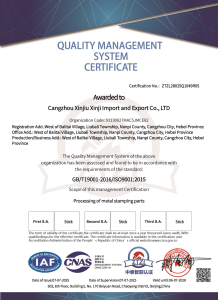
What ISO 9001:2015 Actually Requires
ISO 9001:2015 is a management system standard. The standard does not set part tolerances. It does not test your product. Instead, it requires the factory to manage quality in a controlled, documented way.
Certified factories must show:
- Defined quality policies and objectives.
- Documented procedures for production and inspection.
- Records that prove the procedures were followed.
- Corrective action when problems appear.
- Regular internal audits and management review.
The certificate proves the system exists. It proves the factory can document what it does.
What It Means for a Metal Stamping Supplier
A stamping supplier under ISO 9001:2015 runs inspection at defined stages. In practice, an ISO 9001:2015 certified metal stamping supplier runs five checkpoints per order.
- Incoming material certificates are checked first.
- First-off parts are approved before mass production.
- In-process patrols catch drift early.
- Final inspection uses calibrated gauges and CMM equipment.
- Records are kept for every batch.
The system creates traceability. If a defect appears, we can trace it to material, machine and operator. That traceability is the real value of the certificate. Ask an ISO 9001:2015 certified metal stamping supplier for batch records before you order.
What ISO 9001:2015 Does NOT Prove
Be clear about the limits of the certificate.
- It does not prove the factory makes good parts.
- It does not cover product design standards.
- It does not replace process-specific certifications.
- It does not guarantee on-time delivery.
Medical devices need ISO 13485. Automotive parts often need IATF 16949. Aerospace may need AS9100. Ask which standard fits your industry, and check whether the supplier holds it.
How a Buyer Should Verify the Certificate
Follow these five checks before you accept any ISO claim.
- Request the certificate file, not a logo.
- Note the certificate number and issuing body.
- Confirm the certified company name matches your supplier.
- Confirm the certified scope includes stamping or fabrication.
- Check the expiry date and audit cycle.
Our factory certificate is ISO 9001:2015. Certificate number: 【ZL19071230272371】. Issuing body and scope can be verified on request.
Certification Alone Is Not Enough
A certificate is a baseline, not a guarantee. Pair it with practical checks.
- Video audit of the production line.
- Sample order with full inspection reports.
- Pilot batch to test repeatability.
- Reference projects in your industry.
We welcome all of these checks. Xinjiuxinji Hardware was established in 1999 in Nanpi, Hebei, China. Our factory employs 120+ people, including 19 engineers. It covers about 9,000 square meters.
FAQ
Q: Does ISO 9001:2015 guarantee part quality? A: No. It guarantees a controlled quality system. Verify the system with samples, audits and inspection records.
Q: Which ISO version should I look for? A: ISO 9001:2015 is the current version. Older versions like 9001:2008 are no longer valid for new certification.
Q: Can a small factory be ISO certified? A: Yes. Certification depends on the system, not company size. Verify scope and records regardless of size.
Q: What other certificates matter for metal parts? A: ISO 13485 for medical, IATF 16949 for automotive, AS9100 for aerospace. Match the certificate to your industry.
Start Your Project Today
How to start your project
- Send your 2D or 3D drawings with material and quantity.
- Receive a free quote within 8 hours on working days.
- Approve samples, then mass production starts with staged quality checks.


