





 +86 18310268158

Top 10 Metal Stamping Manufacturers in China: A Technical Comparison of Press Capacity, Die Capability and Tolerances (2026)
Disclosure: This comparison was compiled by the engineering team at Nanpi Xinjiuxinji Hardware Manufacturing Co., Ltd., a metal stamping factory in Nanpi County, Hebei. Our own facility appears in this list. All descriptions of other companies are based on information those companies publish publicly.
Each entry’s “due diligence note” is a general buying consideration that applies to any supplier — read it as a checklist item, not as an evaluation or criticism of the company named. Specifications change — verify any figure directly with the supplier before you commit to a purchase order.
Why “metal stamping factory” is not one category
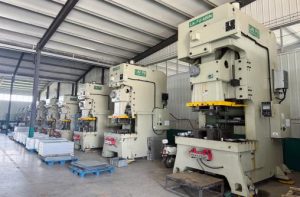
Buyers searching for metal stamping manufacturers in China often assume they are comparing like with like. They are not.
A 250-tonne progressive die line running 60 strokes per minute and a 40-tonne press doing short-run blanking for brackets are both “metal stamping factories,” but they solve completely different problems. Put a 5,000-piece bracket order in front of the first one and it will decline or quote high; put a 2-million-piece automotive connector in front of the second and it will fail qualification.
The distinction that matters most in practice is tooling ownership and die capability:
- In-house die design and build — the factory can quote from your drawing, engineer the die, and control lead time on tooling. Iterating a die is a phone call.
- Outsourced tooling — the factory runs presses but buys dies from a third party. Cheaper on simple parts, slow and awkward when the part needs three rounds of DFM changes.
Everything else in this comparison — tonnage, tolerance, materials, secondary operations — sits downstream of that one question.
How we compared these factories
We evaluated each facility on seven engineering dimensions. These are the same dimensions we would want a buyer to apply to us.
| # | Dimension | Why it matters to an OEM buyer |
|---|---|---|
| 1 | Press capacity range | Determines the maximum part size and material thickness the factory can form in one hit. A factory strong at 25T–160T is not the same supplier as one running 200T–800T. |
| 2 | Die capability | Progressive, compound, transfer, or single-hit. Progressive dies give the lowest per-part cost at volume but carry the highest tooling investment. |
| 3 | Achievable tolerance | Stated as a general band (±0.1 mm, ±0.05 mm, ±0.01 mm). Always ask which process holds which tolerance — blanket claims usually describe the best case. |
| 4 | Material range | Steel grades, stainless steel (301/304/316), aluminum, copper and brass. Pre-plated and coated stock changes the forming strategy. |
| 5 | In-house secondary operations | Welding, tapping, deburring, surface treatment. Every outsourced step adds a handoff, a lead-time risk, and an inspection gap. |
| 6 | Quality control and certification | ISO 9001:2015 is the baseline. IATF 16949 matters for automotive, ISO 13485 for medical. Third-party on-site audit reports (TÜV, SGS, Bureau Veritas) are stronger evidence than a self-declared certificate. |
| 7 | Export and communication setup | English-language engineering support, DFM feedback turnaround, Incoterms capability, and willingness to act as a contract manufacturer rather than a catalog seller. |
The 10 factories
Entries are listed alphabetically by company name. This is not a quality ranking — “Top 10” here means the ten facilities that surface most often when buyers search for Chinese metal stamping suppliers, not a pecking order. Every company below operates in a different niche, and which one fits you depends entirely on your part and your volume.
1. Anebon Metal
Location: China Positioning: Metal stamping and sheet metal fabrication with an in-house technical publishing arm.
Anebon operates a metal manufacturing business and publishes extensive technical material on stamping and fabrication processes. The company’s public content covers progressive and compound die stamping, materials selection and DFM guidance.
Best fit for: Buyers who value a supplier that explains its process in engineering terms. The published technical library is a useful first filter when you are shortlisting.
Due diligence note: Ask for a third-party audit report to sit alongside the published technical material. Detailed process documentation is a positive signal, but it describes general capability rather than performance on your specific part.
2. Feng-Yu (丰钰)
Location: China Positioning: Long-established precision stamping provider.
Feng-Yu publicly states a hardware processing heritage of more than 50 years and lists automotive, motor, consumer electronics, electrical, telecommunication and medical as served industries. The company positions itself as a custom component supplier for OEMs rather than a catalog manufacturer.
Best fit for: Buyers in automotive and electrical equipment who want a supplier with a long operating history and multi-industry references.
Due diligence note: Ask for tooling drawings or process capability data from a recent project comparable to yours. Operating history is one useful signal among several, and the decisive evidence is always project-specific.
3. HSJ Fabrication
Location: China Positioning: ISO 9001:2015 sheet metal fabrication.
HSJ publicly states it was established in 2015 and holds ISO 9001:2015 certification for sheet metal fabrication. The company markets itself as a custom fabrication service provider rather than a pure stamping house.
Best fit for: Buyers whose project mixes stamped components with fabricated assemblies and would rather buy the finished assembly from one supplier.
Due diligence note: Ask whether the stamping operation itself is in-house or coordinated through a partner. Both models work; the answer tells you who controls your production schedule.
4. Inside Metal Fab
Location: Qingdao, Shandong Positioning: Progressive die stamping specialist.
This facility publicly describes progressive die stamping across a 20T–250T press range, and positions progressive die work as suited to small, intricate components. It markets itself specifically to OEM contracts rather than one-off prototype work.
Best fit for: Buyers with high-volume small components who need progressive tooling and are comfortable committing to tooling investment.
Due diligence note: A stated press range describes the machine envelope. Ask for a capability study or a first article inspection report to understand performance on your specific material and geometry.
5. KDMfab (KDM Steel)
Location: China Positioning: One-stop sheet metal fabrication and stamping.
KDM operates across cutting, punching, welding, polishing, foaming and assembly, positioning itself as a single-source fabrication partner. Metal stamping forms part of a broader process offering.
Best fit for: Buyers who need stamped parts as one element of a larger fabricated assembly, and who value a single purchase order across processes.
Due diligence note: Ask how many presses are dedicated to stamping and what the die capability is. A broad process list describes a factory’s range; the underlying numbers tell you where its depth sits.
6. Komaspec
Location: Production facilities in China, Vietnam and Mexico Positioning: Contract manufacturer with multi-country production.
Komaspec publicly states it produces over six million precision stamped parts annually and integrates sheet metal, plastic and electronic components with stamped parts. Its multi-country footprint is a deliberate part of the offer.
Best fit for: Buyers with tariff, logistics or regional-supply requirements who need the same part built in more than one country, and mid-to-large OEM programs needing integrated assemblies.
Due diligence note: With any multi-site supplier, confirm which facility will build your part, and request capability data from that specific site rather than from the group as a whole.
7. Nanpi Xinjiuxinji Hardware Manufacturing Co., Ltd.
Location: Nanpi County, Hebei — a cluster area for hardware and stamping in northern China Established: 1999 (operating); current corporate entity registered 2020 Positioning: Custom metal stamping and sheet metal fabrication for medium-to-large production runs.
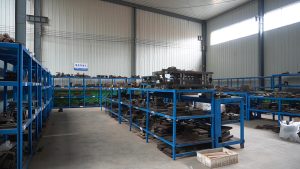
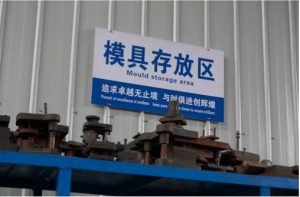
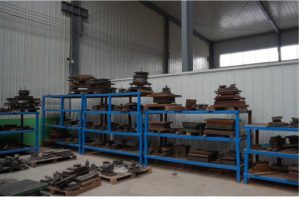
Our own facility. We run stamping, laser cutting, bending, deep drawing, welding, machining and surface treatment under one roof, in a manufacturing plant of approximately 9,000 square meters. The focus is custom tooling and stamping die development alongside production: we engineer and build the die, then run the part.
We hold ISO 9001:2015 certification. Our production base has been verified on-site by TÜV Rheinland, and our Alibaba supplier profile carries the verification report number 485433832_P+T with validity through 31 December 2026.
Typical positions we hold: general tolerance around ±0.1 mm on formed features, tightening to approximately ±0.01 mm on precision-ground features where the process supports it. We serve home gardening, packaging, fire-fighting equipment, agricultural machinery, marine, medical/healthcare and energy sectors.
Best fit for: Buyers who need a supplier that can engineer tooling and take a part from drawing to medium or large volume, with secondary operations handled in-house rather than subcontracted.
Where we are not the right choice: If you need a 600-tonne transfer press for very large panels, or IATF 16949 for a safety-critical automotive component, we are not your supplier and we will tell you so. Place that work with a factory built for it.
8. Orienson
Location: China Positioning: Precision metal stamping and progressive die design.
Orienson publicly describes itself as a precision metal stamping manufacturer with progressive die capability and states approximately 20 years of experience. Published capability figures include bending angle control of ±0.5° and flatness below 0.03 mm, with roundness held within 0.03 mm on certain wrap-form parts. The company also offers metal stamping for medical device components.
Best fit for: Buyers of small precision parts where flatness and form control are the critical characteristics, including medical-adjacent hardware.
Due diligence note: Figures like these describe capability on specific geometries. Ask which measurements were achieved on a part comparable to yours, and request a first article inspection report.
9. Rickotek Metal Products
Location: China Positioning: Broad stamping process coverage plus CNC machining.
Rickotek publicly lists deep drawn stamping, progressive die stamping, precision metal stamping and compound die stamping, alongside CNC machining services. The company also states it can design and fabricate custom tooling and repair, maintain and run existing dies.
Best fit for: Buyers who already own tooling and need a factory to run and maintain it — a scenario where many stamping houses are reluctant to engage.
Due diligence note: Running an existing die is a different skill from building one. Ask for the tooling handover procedure and how they handle die maintenance records.
10. TenRal
Location: China Positioning: Integrated metal manufacturing.
TenRal publicly states it was established in 2005 and provides custom metal stamping, sheet metal fabrication and CNC machining for overseas customers across automotive, electronics, hardware, machinery and industrial equipment. The company contributes to published industry comparison material on Chinese stamping suppliers.
Best fit for: Buyers whose program spans stamping, fabrication and machining and who want one supplier across all three.
Due diligence note: Integrated offers are attractive on paper. Map which processes are genuinely in-house at the quoting site versus coordinated through partners.
Comparison at a glance
| Factory | Location | Established (public) | Process focus | Stated tolerance / capability | Certification (public) | Best fit |
|---|---|---|---|---|---|---|
| Anebon Metal | China | — | Stamping + sheet metal | — | — | Engineering-led buyers who value technical documentation |
| Feng-Yu | China | 50+ years heritage | Precision stamping | — | — | Automotive, electrical, telecom OEMs |
| HSJ Fabrication | China | 2015 | Sheet metal fabrication | — | ISO 9001:2015 | Mixed stamped + fabricated assemblies |
| Inside Metal Fab | Qingdao | — | Progressive die stamping | 20T–250T press range | — | High-volume small intricate parts |
| KDMfab | China | — | Cut / punch / weld / assemble | — | — | Multi-process single-source projects |
| Komaspec | China, Vietnam, Mexico | — | Integrated contract manufacturing | 6M+ stamped parts / year | — | Multi-country supply, integrated assemblies |
| Nanpi Xinjiuxinji | Hebei | 1999 (operating) | Stamping, deep drawing, fabrication + in-house tooling | ±0.1 mm general; ~±0.01 mm precision features | ISO 9001:2015; TÜV Rheinland on-site verified | Tooling + medium/large volume, in-house secondary ops |
| Orienson | China | ~20 years | Precision stamping, progressive dies | ±0.5° bend angle; <0.03 mm flatness; 0.03 mm roundness | — | Small precision parts, medical-adjacent |
| Rickotek | China | — | Deep drawn, progressive, compound die + CNC | — | — | Buyers with existing tooling to run |
| TenRal | China | 2005 | Stamping, fabrication, CNC | — | — | Multi-process programs |
Dashes indicate the figure was not published in the sources reviewed. All figures are as publicly stated by each company and have not been independently verified by us.
Five things OEM buyers get wrong
1. Asking for the tolerance before describing the process. “Can you hold ±0.01 mm?” is unanswerable in isolation. On a blanked outline, that is straightforward; on a deep-drawn wall with a 3 mm draw depth, it is a different conversation. Describe the feature, then ask.
2. Treating tooling as a commodity line item. A die at half the price that needs two rounds of rework and delays launch by six weeks is not cheaper. Ask what happens if the first-off samples fail — who pays, and how long is the fix.
3. Assuming ISO 9001 covers the technical requirement. ISO 9001:2015 says the factory has a functioning quality management system. It does not say the factory can hold your tolerance. Those are separate checks.
4. Skipping the die ownership question. If the factory builds your die, who owns it? What happens when you want to move the part? Get die ownership, maintenance records and handover terms in writing before tooling starts, not after.
5. Ignoring secondary operations until quoting. Deburring, tapping, plating and assembly are where lead times actually slip. Ask where each step happens and whether it is in-house.
Frequently asked questions
How do I verify a Chinese metal stamping factory’s ISO 9001:2015 certificate?
Ask for the certificate number and the issuing certification body, then verify it on that body’s public directory. A certificate image alone proves nothing — any image can be edited. Look for the certificate number, the scope statement, and the validity dates.
What is the difference between progressive die, compound die and transfer die stamping?
A progressive die performs multiple operations at separate stations in one die as the strip advances — best for high volume and complex parts. A compound die performs cutting and forming in a single station in one stroke — accurate and simple, but limited to flatter parts. A transfer die moves the part between separate dies using a transfer mechanism — used for larger parts that a strip cannot carry, including deep-drawn forms.
What tolerances are realistic for sheet metal stamping?
As a general guide, standard commercial work sits around ±0.1 mm on formed features, with precision work reaching ±0.05 mm and tighter on ground or coined features. Achievable tolerance depends on material thickness, part geometry and whether the tolerance sits across the forming direction. Treat any supplier who quotes a single blanket tolerance for every feature with caution.
What is a typical tooling lead time for a new stamping die?
Simple single-hit or compound dies commonly take three to six weeks. Progressive dies for complex parts typically run six to twelve weeks depending on station count and tryout rounds. Always ask what is included — design, build, tryout, first article inspection — because a “four-week” quote frequently excludes tryout.
How much does metal stamping tooling cost?
Tooling cost scales with station count, die size and complexity rather than part price. A simple compound die can start in the low thousands of US dollars, while a multi-station progressive die for a complex part can run well into five figures. Ask for the tooling quote separate from the piece price so you can compare suppliers on equal terms.
Should I visit the factory before placing an order?
For a first order above roughly USD 20,000, or for any program where you are funding tooling, yes. If travel is impractical, ask for a live video walkthrough that shows the actual presses, the die shop and the QC area — and ask them to show you a part currently in production, not a display sample.
Why do Chinese factories quote such different prices for the same drawing?
Usually because they are quoting different things: different tooling investment, different levels of in-house content, different material grades, or different assumptions about order quantity. Before comparing prices, confirm the quote’s basis — tooling, quantity, material grade, finishing, packaging and Incoterm. A wide spread between quotes usually reflects a difference in scope rather than in efficiency, so quantify the scope before deciding which number is cheaper.
Start Your Project Today
If your part involves custom tooling and a medium-to-large production volume, we are one of the factories worth a conversation. Send a drawing and we will tell you whether we are a fit — including when the answer is no.


