





 +86 18310268158

Deep Drawing Design Guide: Materials, Tolerances & Tooling
Deep drawing turns flat sheet metal into hollow parts. Cups, shells and housings all start as flat blanks. Good design makes the process stable. Poor design makes defects no tooling can fix. This deep drawing design guide covers the decisions that shape your tooling.
Xinjiuxinji Hardware has run deep drawing on our own presses for 26 years. The factory was established in 1999 in Nanpi, Hebei, China. We share these design rules from daily production.
What Deep Drawing Is
Deep drawing pulls sheet metal into a die cavity with a punch. A blank holder holds the blank edge in place. Material flows into the wall instead of stretching thin.
It differs from shallow forming. Parts deeper than half their diameter are usually considered deep drawn. The process suits cups, battery housings, sinks, and enclosures.
Material Selection for Deep Drawing
Material formability decides success. Choose grades with good elongation and stable thickness.
| Material | Drawability | Common Use |
|---|---|---|
| Low-carbon steel (DC01, DC04) | Excellent | Housings, cups, automotive |
| Stainless 304 | Good | Food, kitchen, medical |
| Stainless 316 / 316L | Good | Corrosion environments |
| Aluminum 5052, 5054 | Good | Lightweight parts |
| Aluminum 6061 | Fair | Moderate shapes only |
Higher elongation means deeper draws before annealing. Thickness variation changes flow and defects. Specify tight material tolerances for deep drawn parts.
Key Design Rules
Limit the Draw Ratio
Draw ratio compares blank diameter to punch diameter. A safe single draw ratio for steel is about 1.6 to 1.9, typical. Higher ratios need multiple draws with intermediate annealing.
Design with the ratio in mind. A deep part is not one big draw. It is a series of controlled draws.
Add Generous Corner Radii
Sharp corners stop material flow. Radius size controls stress and thinning.
- Bottom radius: at least 3 to 5 times material thickness, typical.
- Wall radius: as generous as the design allows.
- Flange radius: larger is safer.
Small radii cause bottom tearing. If the design needs a sharp corner, plan a secondary operation.
Allow Wall Thickness Variation
Deep drawing does not hold uniform wall thickness. Walls thin near the top of the draw. Typical thinning of 10 to 20 percent is normal for steel. Design strength for the thinnest section.
Plan for Springback
Steel and aluminum spring back after forming. Compensation happens in the die. Higher-strength material springs back more. Confirm the final shape with trial samples before mass production.
Typical Tolerances for Deep Drawn Parts
Tolerance depends on material, size and tooling condition. Values below are typical references, not guarantees.
| Feature | Typical Tolerance |
|---|---|
| Drawn diameter | ±0.15 mm |
| Part height | ±0.30 mm |
| Wall thickness | Natural variation, not a machined value |
| Hole positions after secondary piercing | ±0.10 mm |
| Flange flatness | Depends on material and thickness |
Send drawings for a feasibility check. Our engineers confirm achievable tolerances before tooling starts.
Tooling Decisions
Tooling decides cost, speed and part quality. The second half of this deep drawing design guide covers die options and lead time.
- Single-action dies suit simple draws.
- Progressive dies combine drawing with blanking and piercing.
- Compound dies perform several operations per press stroke.
- Tool steel selection follows production volume.
Tooling lead time typically ranges from two to six weeks. Simple dies are faster. Progressive and compound dies take longer.
Tooling cost spreads across volume. State your annual quantity when quoting. We will match the die design to your volume.
Common Defects and Fixes
- Wrinkling on flange: increase blank holder force.
- Tearing at the bottom: increase radius or add a draw step.
- Excessive thinning: lower the draw ratio.
- Springback distortion: adjust die compensation.
- Surface scratches: improve die polish and lubrication.
Every defect has a controllable cause. That is why process data matters. Our factory inspection covers first-off parts before mass production runs.
Our Deep Drawing Capability
Xinjiuxinji Hardware operates 40 stamping presses from 80 to 400 tons. Our largest presses handle deeper and larger drawn parts. We combine deep drawing with laser cutting, bending, welding and surface treatment in-house.
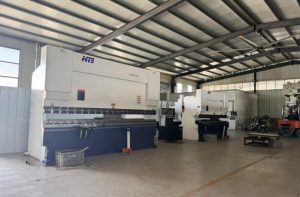
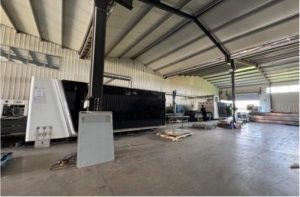
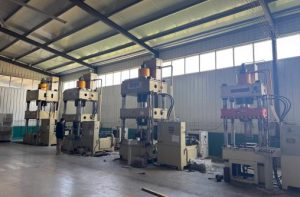
The factory employs 120+ people, including 19 engineers. It is certified to ISO 9001:2015 and covers about 9,000 square meters. Since 1999, we have customized more than 70,000 types of metal parts.
FAQ
Q: What is the difference between deep drawing and stamping? A: Stamping cuts and forms sheet metal. Deep drawing pulls sheet into hollow shapes deeper than half the diameter.
Q: What is the maximum depth for a deep drawn part? A: Depth depends on material, diameter and tooling. Multiple draws allow much deeper parts. Send drawings for a feasibility answer.
Q: Which materials are best for deep drawing? A: Low-carbon steel draws best. Stainless 304 and 316 draw well. Aluminum 5052 suits many lightweight parts.
Q: Do deep drawn parts need machining after drawing? A: Only where tight features are required. Holes, threads and critical faces are often pierced or machined in secondary steps.
Start Your Project Today
Use this deep drawing design guide as your pre-tooling checklist. Deep drawing quality starts at the drawing stage. Send your design today. Get a free quote for custom deep drawn metal parts within 8 hours.


