


 +86 18310268158
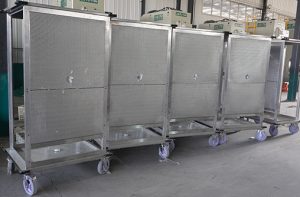
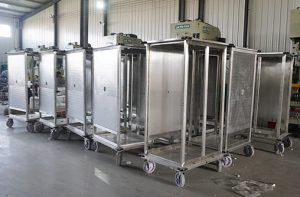
Customized Metal Cabinet: Hotel Back Kitchen Storage Cabinet
Whether it’s the mobile refrigeration cabinets in the hotel kitchen, the food storage racks in the commercial kitchen, or the electrical control cabinets in industrial settings, behind every Customized metal cabinet lies the complete chain of technical expertise from material selection and structural design to precise fabrication.
This article uses a mobile insulated cabinet in a hotel kitchen as a typical example. It comprehensively presents our fabrication process and quality control system.
Material and Design
Everything begins with the selection of materials
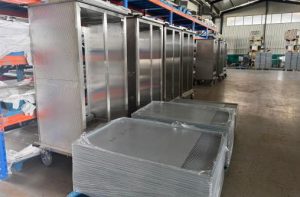
The hotel’s commercial kitchen is exposed to water vapor, oil stains, and cleaning agents for extended periods, thus requiring extremely high corrosion resistance in the equipment.
The main body is entirely made of 304 stainless steel sheet, with a service life far exceeding that of ordinary 201 stainless steel products.
The commonly used sheet thickness is 0.8mm to 1.0mm, while the force-bearing columns and bottom frame are thickened to 1.2mm to 1.5mm to ensure load-bearing strength.
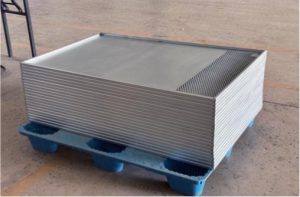
In terms of appearance, the matte brushed stainless steel plate is paired with the patterned side anti-slip stainless steel plate, which resists scratches and oil stains.
The cabinet frame is constructed with 304 stainless steel rectangular tubes/flexible tubes to form the load-bearing structure. At the bottom, industrial PU silent swivel wheels (with brakes) and stainless steel wheel brackets are installed.
💡One of the main advantages of custom metal cabinets is their non-standard customization: sizes can be flexibly adjusted to customer requirements, and the internal structure can be compatible with standard GN pallet slots.
Fabrication Frocess
A customized metal cabinet, from raw steel to finished product, undergoes the following complete process:
Initial process: design and cutting
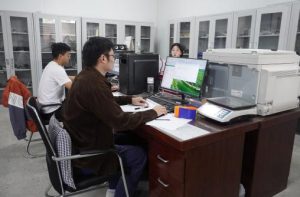 First, conduct CAD sheet metal unfolding and disassembly: the side panels, door panels, frames, perforated mesh panels, and supporting components are disassembled one by one, and unfolding diagrams and layout plans are drawn.
Then, use laser cutting to complete the material cutting. Cut the stainless steel plate to shape and various holes (wiring holes, ventilation holes, door lock holes, temperature control installation holes). Laser cutting provides high precision and smooth edges, laying the foundation for the subsequent shaping process.
Forming process: bending and punching
The cut plates then proceed to the bending stage. All the panel edges, slots, and box edges are formed in one step.
The punching process is carried out simultaneously. The side ventilation micro-hole plates use pre-made punching. At the same time, the bottom of the cabinet is processed with long strip heat dissipation holes. The stainless steel square tubes are cut and polished at the ends before being stored.
Assembly connection: combining welding and riveting methods
We adopt two connection methods that coexist:
- Welding: Connection of stainless steel frame skeleton, spot welding/mounting welding at the load-bearing points of the cabinet body;
- Riveting/Blind Rivets and Bolts Assembly: A large number of rivets are used for the assembly of the inner and outer skins with the frame, effectively reducing large-scale welding deformation.
Both ensure the structural strength and control the appearance quality.
Surface treatment: special process for stainless steel
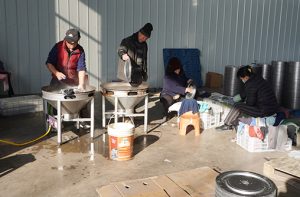 The stainless steel is professionally acid-washed and passivated to remove welding marks and prevent rusting at the welding points. Subsequently, the surface is polished, repaired, cleaned, and degreased to prepare for the final assembly.
Assembly process
Assembly of double-layer cabinet → Filling the inner space with insulation materials → Installing baking tray rails, door frames, hinges, and door locks → Installing stainless steel casters and swivel wheels at the bottom → Making electrical holes and assembling temperature control, heating components, and sealing strips → Conducting water tests, assembly checks, quality inspections, and packaging.
Challenges and Our Solutions
- Thin stainless steel welding deformation | Solution: intermittent welding + tooling fixation; pickling/passivation/polishing; riveting prioritized
- Double-layer insulated cabinet dimensional accuracy | Solution: ±0.5mm bending tolerance; full tooling positioning for frame welding
- Perforated mesh plate flatness | Solution: precise edge folding + dedicated assembly fixtures
- Mass production consistency | Solution: standardized fabrication for full interchangeability
- Kitchen environment corrosion & deformation risks | Solution: weld passivation + blue dot test; sealed rivet gaps; 2.0mm reinforced caster pads
- Sealing & insulation performance | Solution: elastic compensation mold for ±0.2mm slot precision; silicone seal press-fit; post-foaming temperature test
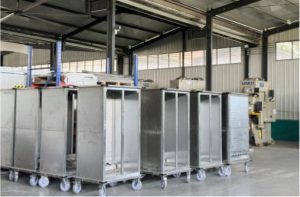
After delivery, there were no customer complaints within half a year. Subsequently, the customers continued to place orders. As of now, we have delivered a cumulative total of tens of thousands of custom cabinets. We welcome you to schedule a factory visit to inspect our Fabrication production line and quality control process on-site.
Start Your Next Project
Whether you need a customized metal cabinet for the hotel kitchen or a non-standard cabinet for an industrial setting, we can offer a complete fabrication solution from design drawings to finished products.
Click the button on the right to contact us immediately and send us the drawings or requirements.