





 +86 18310268158

316L Stainless Steel Fabrication: Complete Guide for Custom Parts
316L stainless steel fabrication shapes a low-carbon, molybdenum-alloyed steel into parts built for harsh service. Shipbuilders, chemical plants, and food processors rely on this grade. It resists salt water, chlorides, and many acids. The low carbon limit also protects welded joints.
This guide suits engineers, buyers, and project managers. It explains how 316L behaves in real production. You will see what to specify and what to avoid. You will also learn how we verify quality at each stage.
Why 316L Outperforms 316 in Welded Fabrication
316 and 316L belong to the same austenitic family. Their practical difference is carbon content. Standard 316 allows up to 0.08% carbon. 316L stays at 0.03% or below. That gap determines how welds age.
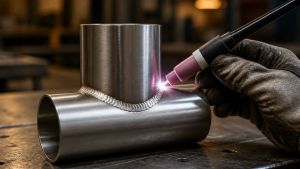
When you weld 316, heat can make carbon react with chromium. This forms chromium carbide at grain boundaries. That zone then loses corrosion resistance. This process is called sensitization. 316L leaves too little carbon for it to occur. Welded joints therefore keep their protective oxide layer. Thick sections and multi-pass welds benefit most.
Both grades add molybdenum for chloride resistance. In 316L parts, that resistance survives welding and forming. It also survives deep drawing and bending cycles. The grade costs more than standard 304. It pays back where downtime, leaks, or replacement are expensive. For welded assemblies in wet service, the extra cost is easy to justify.
| Property at a glance | 316 | 316L |
|---|---|---|
| Max carbon content | 0.08% | 0.03% |
| Sensitization risk when welded | Higher | Minimal |
| Post-weld heat treatment | Often needed | Rarely needed |
| Corrosion resistance after welding | Reduced at heat zone | Maintained |
| Best fit | Unwelded marine parts | Welded assemblies, chemical, medical |
316L Stainless Steel Fabrication Processes We Run In-House
Every step below must respect how 316L reacts to heat and pressure.
- Laser cutting — Fiber lasers cut clean profiles with a narrow heat zone. Edges keep their corrosion resistance when gas settings are right. Complex shapes and tight nesting come out consistently. We process sheet, plate, and tube on the same line.
- Stamping and deep drawing — 316L work-hardens faster than 304 during forming. We control lubrication and blank treatment for deep draws. Annealing between deep draw stages prevents cracking. Dimensional stability holds across long production runs.
- Bending and forming — 316L springs back more than softer stainless grades. Tooling compensates through careful bend allowances. Angles stay identical from first part to last.
- Welding — TIG and MIG welding both suit 316L. The low carbon content removes post-weld treatment in most cases. Matching 316L filler keeps welds as resistant as the base metal. Shielding gas keeps joints clean and strong.
- CNC machining — CNC steps add accurate holes, threads, and edges after forming. Machined details stay true to the drawing.
- Surface finishing — Pickling and passivation rebuild the protective layer. Brushing, electropolishing, and media blasting set the final look. We match each finish to your duty and appearance needs.
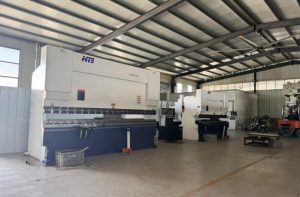
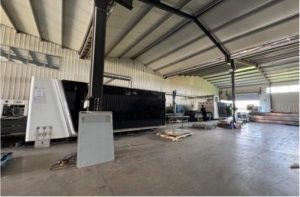
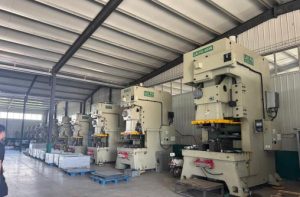
The equipment below covers every process step.
| Process equipment | Configuration |
|---|---|
| Laser cutting | 6 kW fiber laser |
| Stamping and deep drawing | 40+ presses from 80T to 400T; largest 400T single-point |
| Bending | CNC press brakes |
| Welding | Automated and manual TIG / MIG |
| CNC machining | Drilling, milling, and turning |
| Hydraulic presses | Deep forming and assembly |
| Surface finishing | In-house pickling, passivation, brushing |
In-house control shortens lead times and keeps quality stable.🔧Click here to view our complete list of equipment.→
Where Fabricated 316L Parts Earn Their Keep
316L fabrication pays off where chlorides, moisture, or hygiene rules attack steel.
- Marine hardware — Boat fittings and offshore brackets face constant salt. 316L resists pitting where 304 fails early.
- Chemical processing — Tanks, piping, and valve parts meet acids and heat daily. Weld integrity stays intact for years.
- Food and beverage — Welded seams remain cleanable without losing strength. Maintaining compliance with hygiene standards is easier.
- Medical devices — Equipment frames and tools need corrosion-free, cleanable surfaces. The low carbon content keeps them safe through repeated sterilization.
When chlorides are present in the working environment, 316L is the safer default.
Design Notes That Make 316L Parts Easier to Build
Small drawing choices reduce cost and lead time.
- Keep inside bend radii generous where possible.
- Space holes at least two diameters from sheet edges.
- Match wall thickness to the draw depth you need.
- Mark critical tolerances explicitly on the drawing.
- Specify the surface finish early in the project.
- Allow a flat clamping area where bends meet.
Why Buyers Trust Our 316L Fabrication Shop
Our shop employs 120+ people, including 19 engineers. We have produced 70,000+ different types of custom metal parts over the years. Export sales serve the US, Europe, Australia, and Asia.
We handle 316L stainless steel fabrication from drawing review to finished parts. Every project gets a dedicated engineer from quote to delivery. Parts ship only after our ISO 9001:2015 quality system signs off.
FAQ
Does welding 316L keep its corrosion resistance?
Yes. Its low carbon content stops sensitization at the weld. Post-weld heat treatment is rarely needed.
Is 316L harder to form than 304?
It work-hardens faster. Proper lubrication and annealed blanks solve this.
Can laser cutting damage 316L edges?
Poor gas control can. Our settings keep the heat zone small. Pickling restores the surface afterward.
Which finishes suit 316L parts?
Brushed, matte, electropolished, and passivated all work well.
Do you support prototype parts?
Yes. Prototypes confirm fit and finish before volume runs. We then move straight into production.
How fast can you quote my 316L project?
Send the drawing, quantity, and finish. You will receive pricing and a lead time for review.
Start Your Project Today
Start your 316L stainless steel fabrication project with a free quote. Fast quotes start with clear inputs.
- A drawing or model of the part.
- Material grade, thickness, and quantity.
- Required surface finish and tolerances.
- A target delivery date, if you have one.
Clear specifications prevent rework and delays. If details are missing, our engineers flag them before quoting. We reply with pricing, process notes, and a realistic lead time.


